Unlocked vs Carrier Phones: What’s the Difference in the US?
How carrier locks work in the US, how long AT&T, T-Mobile and Verizon keep phones locked, and when an unlocked phone is the smarter buy.
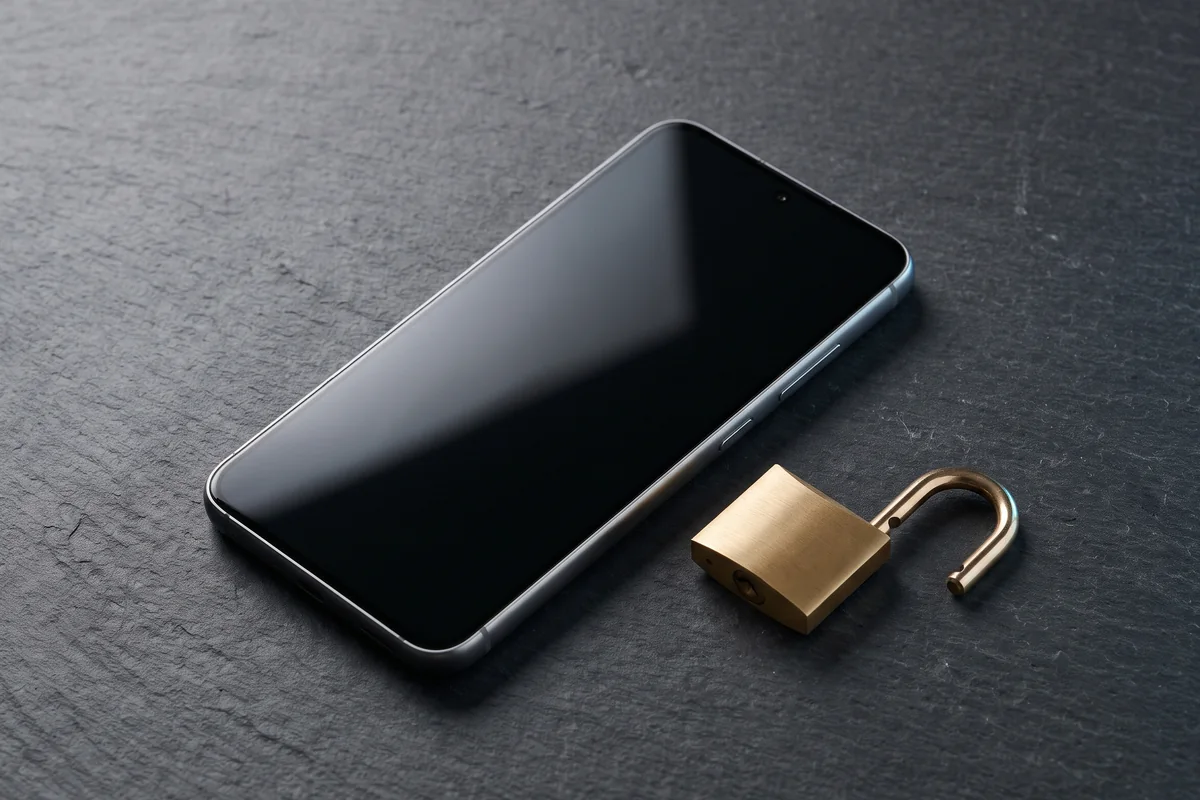
Unlocked vs carrier phone is one of the first choices you make when you buy a phone in the US. A carrier phone comes from AT&T, T-Mobile or Verizon, often with a big discount, but it stays locked to that network for months or even years. An unlocked phone works with any compatible carrier from day one. Here’s how carrier locks really work, the current unlock rules at each major carrier, why an unlocked phone doesn’t automatically work everywhere, and which option makes more sense for you.
The short answer
- A carrier phone is locked to one network until you meet its unlock rules — usually until the phone is paid off, or up to a year on prepaid plans.
- An unlocked phone works on any carrier it’s compatible with, so you can switch carriers, move to a cheaper plan or add a travel eSIM whenever you want.
- The hardware is usually the same. The difference is the lock, the deal attached to it, and sometimes carrier apps and slower updates.
- “Free” carrier phones are bill credits spread over 24 or 36 months. Leave early and you lose the rest of the credits and owe what’s left on the phone.
- Unlocked doesn’t mean universal: the phone still needs the carrier’s bands, 4G calling (VoLTE) and approval. Check the IMEI on the carrier’s website before you buy, especially an imported phone.
- Unlocking is legal and free at the big carriers, but only the carrier that sold the phone can do it.
What’s the difference between an unlocked and a carrier phone?
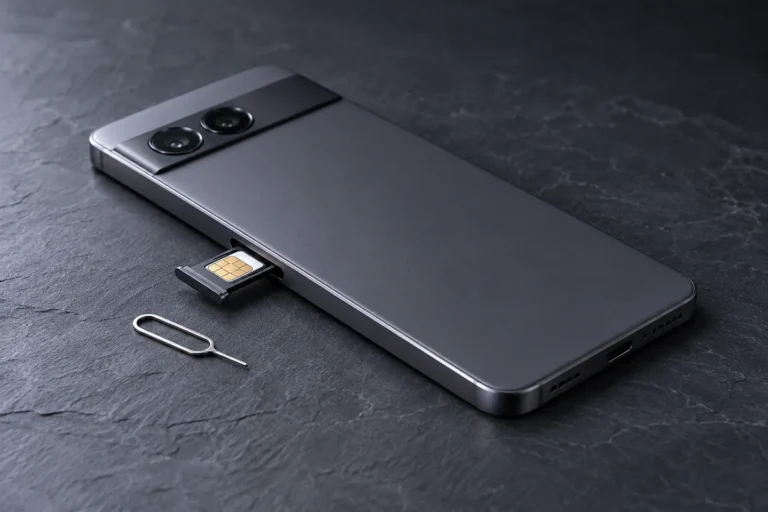
A carrier-locked phone has software that only accepts SIM cards and eSIM profiles from the carrier that sold it. Put in another carrier’s SIM and you’ll see a message like “SIM not supported,” or the new eSIM simply won’t install. The phone still works on Wi-Fi, but it can’t connect to another network until the original carrier removes the lock.
An unlocked phone has no such restriction. It accepts a SIM or eSIM from any carrier, as long as the phone supports that carrier’s network. Phones bought outright from the maker or from big retailers are usually sold unlocked.
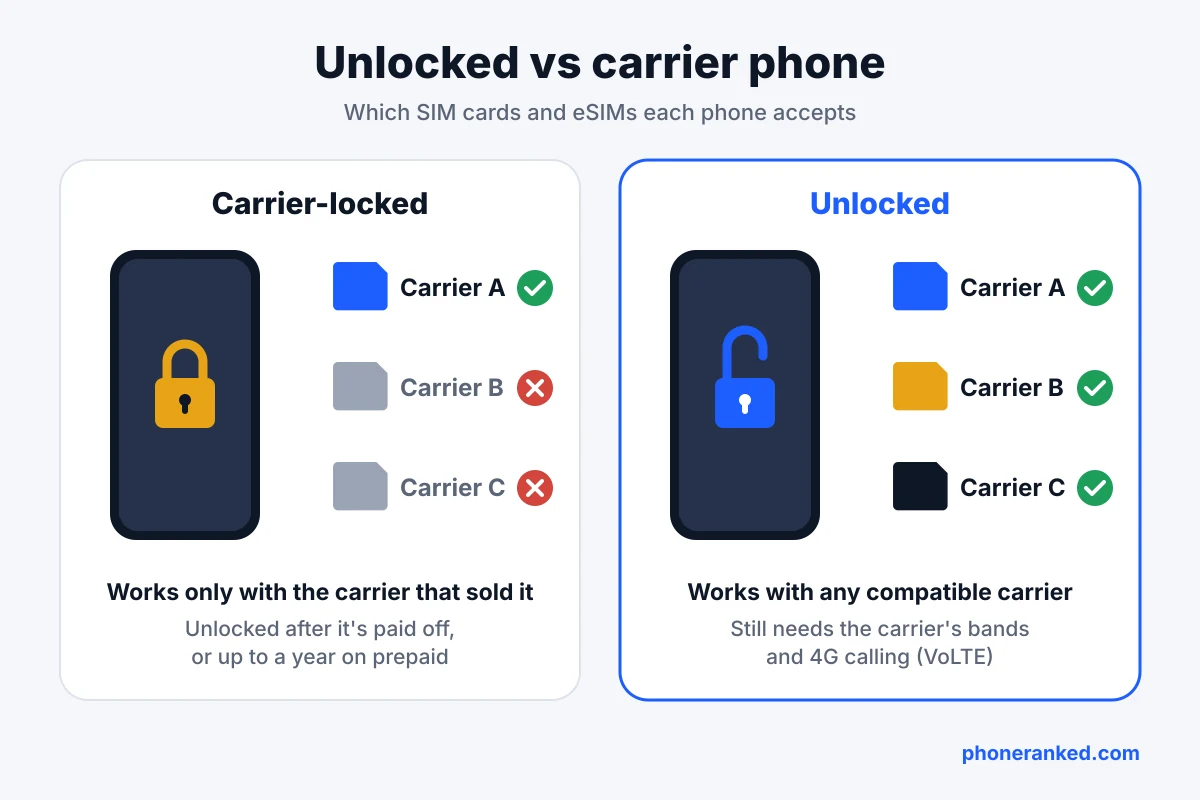
Carriers lock phones for two reasons. First, they often sell phones below full price or on monthly payments, and the lock makes sure you stay long enough to pay the phone off. Second, locks make stolen or fraudulently bought phones harder to resell, which carriers say is a big problem.
In the US, “carrier phone” can mean two slightly different things: a phone that is locked to a carrier, and a carrier model that runs the carrier’s version of the software. Samsung is a good example. Its US Galaxy phones end in “U” for carrier models and “U1” for factory unlocked models, for example SM-S931U and SM-S931U1. The hardware is the same, but a carrier model keeps the carrier’s apps and update schedule even after it’s unlocked.
| Carrier phone | Unlocked phone | |
|---|---|---|
| Where you buy it | AT&T, T-Mobile, Verizon and their prepaid brands | The phone maker or big retailers |
| Price | Big discounts, paid as bill credits over 24–36 months | Full price, or the maker’s own financing and trade-in deals |
| Switching carriers | Only after the unlock rules are met | Any time |
| Local SIM or travel eSIM abroad | Not until it’s unlocked | Yes |
| Software | Often extra carrier apps and a carrier boot screen | The maker’s software only |
| Updates | Sometimes days or weeks later | Straight from the maker |
| Reselling | Needs to be unlocked first to sell easily | Easier to sell to anyone |
| Carrier features (Wi-Fi calling, 5G, HD Voice) | Set up and tested for that carrier | Work on US models from major brands; check imports |
The software differences are smaller than they used to be, but they’re real. Carrier models get every update only after the carrier tests it, so they can trail unlocked models by days or weeks. You’ll find more on that in our guide to how long phones get updates.
Are carrier phones cheaper? How carrier deals really work
Carrier deals look unbeatable: “$1,000 off” or even a “free” phone. In practice, almost every big carrier deal works the same way. You buy the phone at full price on a monthly installment plan, usually over 24 or 36 months, and the carrier cancels each payment with a bill credit. Stay until the last month and the phone has cost you little or nothing.
The catch is in the conditions:
- You have to stay. Cancel your line early and the remaining credits stop, while the unpaid balance on the phone comes due.
- You have to keep the right plan. The best deals usually require a premium unlimited plan, often with a trade-in or a new line. Move to a cheaper plan and the credits can stop.
- Paying off early can cost you. At some carriers, paying off the phone ends the remaining credits too. Read the deal terms before you pay a lump sum.
- The phone stays locked until it’s paid off, so you can’t take it to another carrier halfway through.
A carrier deal is a good one when you’d stay with that carrier on that plan anyway. It’s a bad one when the required plan costs much more than you need. Do the math over the whole term: a plan that costs $30 more per month adds up to $1,080 over 36 months, which is more than many phones cost outright.
How long does a carrier keep a phone locked?
There’s no single US law that sets a lock period. The big carriers follow the industry’s CTIA Consumer Code: they unlock postpaid phones once the contract or device payments are done, unlock prepaid phones no later than one year after activation, and respond to unlock requests within two business days. Each carrier then sets its own exact rules.
| Carrier | Postpaid (monthly plan) | Prepaid | How you get unlocked |
|---|---|---|---|
| AT&T | Paid in full and bought more than 60 days ago | Six months of paid service | Request it online |
| T-Mobile | Paid in full and active on the line for at least 40 days | 365 days since activation, or more than $100 in refills; at least 14 days after purchase | Automatic within two business days, when the phone supports a remote unlock |
| Verizon | Paid in full; a 35-day wait if you pay off online, in the app or with a Verizon gift card | 365 days of paid, active service | Automatic |
Rules as of November 2026. In every case the account must be in good standing, and a phone reported lost or stolen won’t be unlocked. Verizon’s prepaid brands, including Visible, Total Wireless, Straight Talk and Tracfone, also moved to a 365-day lock.
If you’ve read that Verizon unlocks phones after 60 days, that’s outdated. For years Verizon was the only big carrier required to do that, but the FCC waived the rule in January 2026, and Verizon switched to the rules above. The FCC is still weighing a single unlocking rule for all carriers, so check your carrier’s unlock policy page before you sign up.
Will an unlocked phone work on Verizon, AT&T and T-Mobile?
Almost every US phone plan runs on one of three nationwide networks. Cheaper brands use them too: Cricket runs on AT&T, Metro and Mint Mobile run on T-Mobile, and Visible and Total Wireless run on Verizon. So the question is always whether your phone works on the network underneath.
For a phone to work fully on a US carrier, three things have to be true:
- It’s unlocked, or locked to that same carrier.
- It supports the carrier’s main bands — the radio frequencies its network uses for coverage and speed.
- It supports 4G calling (VoLTE) and the carrier approves it. Since the last US 3G networks shut down in 2022, every call runs over 4G or 5G. Carriers check each phone’s IMEI against their own list of approved models. A phone that isn’t on the list may get mobile data but fail to make or receive normal calls.
The good news: the US unlocked versions of iPhones, Galaxy, Pixel and other major brands are built for all three networks and approved by them. The risk is with phones made for other countries.
Which bands does a phone need for US carriers?
Each carrier relies on a few bands more than others. Low bands (600–850 MHz) carry signal far and through walls, so they decide your coverage in rural areas and indoors. Mid bands like n77 and n41 carry most fast 5G traffic in towns and cities.
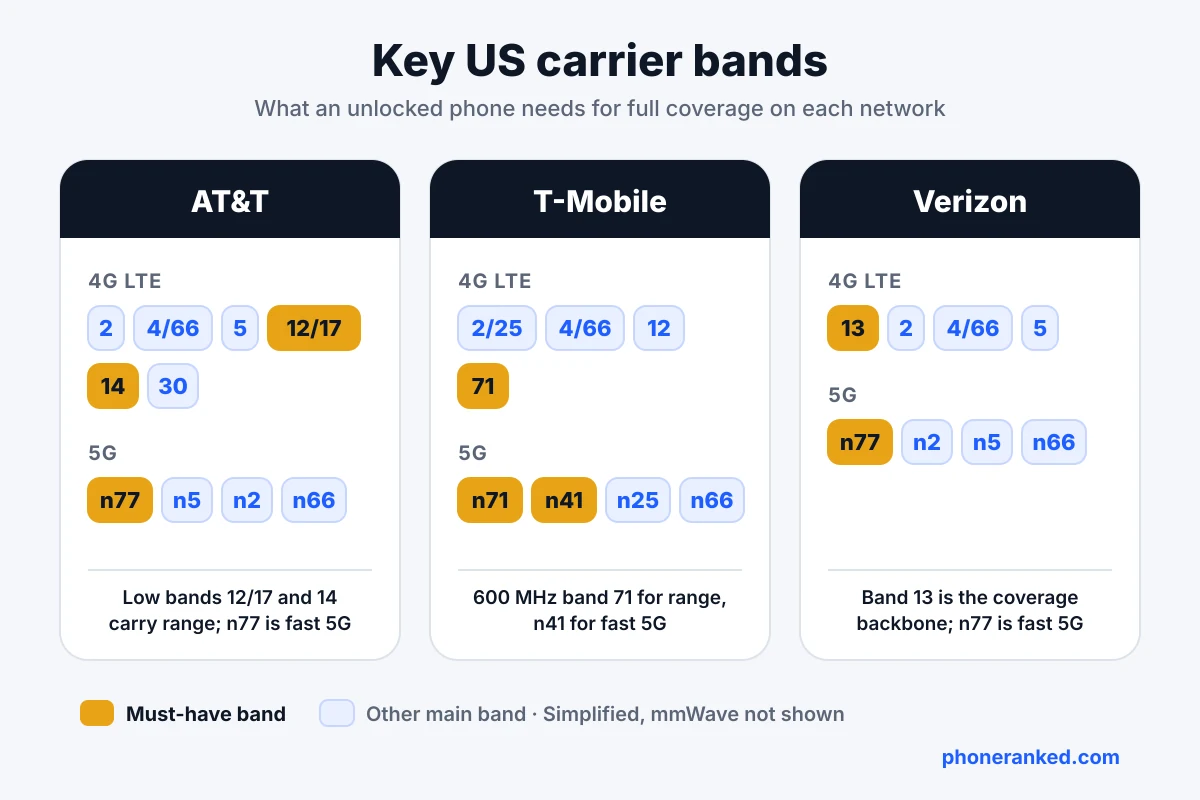
| Carrier | Key 4G LTE bands | Key 5G bands | Don’t buy without |
|---|---|---|---|
| AT&T | 2, 4/66, 5, 12/17, 14, 30 | n77, n5, n2, n66 | LTE 12/17 and 14 (low band), n77 |
| T-Mobile | 2/25, 4/66, 12, 71 | n71, n41, n25, n66 | LTE 71 / n71 (600 MHz), n41 |
| Verizon | 13, 2, 4/66, 5 | n77, n2, n5, n66 | LTE 13 (700 MHz), n77 |
The list is simplified: carriers also use extra bands in some areas, and all three have very fast but very short-range mmWave 5G in dense spots like stadiums and downtowns. If a phone misses a low band, it may still work in a city but lose signal on highways, in rural areas and deep inside buildings. If it misses n77 or n41, it falls back to slower 4G or low-band 5G.
To check a phone before you buy, compare its band list on the maker’s spec page with the table above, then run its IMEI through the carrier’s “bring your own phone” checker. Dial *#06# on any phone to see its IMEI. The checker is the final word on calling and activation.
Buying an imported or international phone in the US
Phones sold in Europe, China or India often look identical to the US model but have different radios, firmware and approvals. Typical problems on US networks:
- Missing bands. T-Mobile’s band 71, Verizon’s band 13 and AT&T’s band 14 are North American bands, so international models often skip them.
- No calling approval. Data may work while calls fail, or the carrier may refuse to activate the phone at all. Each carrier keeps its own list, so a phone that works on T-Mobile can still fail on AT&T or Verizon.
- Missing carrier features like Wi-Fi calling and 5G standalone, which depend on carrier approval.
- No US warranty. The maker’s US service centers may refuse to repair it.
- China-only versions usually come without the Google Play Store and Google apps.
If you want a phone that’s only sold abroad, our ranking of the best Chinese phones marks the models that aren’t sold in the US or Europe. If you’d rather avoid the risk, our list of the best phones in the US includes only phones officially sold here.
How to check if your phone is unlocked
Check the lock before you switch carriers, travel or buy a used phone:
- iPhone: go to Settings > General > About and find Carrier Lock. “No SIM restrictions” means it’s unlocked. Anything else means it’s locked.
- Recent Samsung Galaxy phones: go to Settings > Connections > More connection settings > Network lock status.
- Any phone: insert a SIM, or add an eSIM, from a different carrier. If the phone connects and shows the new carrier’s name, it’s unlocked. If you see “SIM not supported” or a similar error, it’s locked.
- Ask the carrier: your online account or the carrier’s support team can check the lock status by IMEI.
How to unlock a carrier phone
- Check that you qualify. Look up your carrier’s current unlock policy: the phone must usually be paid off, active for a set time and on an account in good standing.
- Pay off the balance the right way. On Verizon, paying in a Verizon-owned store with cash, a chip card or a contactless payment avoids the 35-day wait that applies to online payments.
- Request the unlock if it isn’t automatic. AT&T unlocks through its online request form, which also works if you’re no longer an AT&T customer. T-Mobile and Verizon unlock eligible phones automatically.
- Wait up to two business days. The carrier will either unlock the phone or explain why it can’t.
- Confirm before you cancel. Check the lock status as shown above, then set up the new carrier’s SIM or eSIM. Keep your old line until the new one works.
Skip paid “unlock code” websites. Big carriers unlock their own phones for free, and modern phones can only be unlocked by the original carrier, so these services at best do nothing for your phone and at worst take your money.
Should you buy an unlocked or a carrier phone?
A carrier phone makes sense if you’re happy with your carrier, already pay for the plan the deal requires, and plan to keep the phone for the full 24 or 36 months. Then the bill credits are real savings.
An unlocked phone makes sense if you want a cheaper prepaid plan, travel abroad often, like to switch carriers when a better offer appears, want updates straight from the maker, or plan to sell the phone after a year or two. You can still bring an unlocked phone to a big carrier — some even offer credits for bringing your own phone.
Before you buy either one, check:
- The total cost over the whole term: phone, plan and fees, compared with an unlocked phone on the plan you’d actually choose.
- How long the phone stays locked, and what happens if you leave early or pay it off early.
- Band support and the carrier’s IMEI check, if the phone isn’t sold by your carrier.
- The US model number, if you buy online. A listing that says “international version” won’t necessarily work fully on your carrier.
- The lock status and a clean IMEI, if the phone is used. A phone reported lost or stolen, or one with unpaid carrier payments, can be blocked on every US network.
Quick answers
Is it legal to unlock a phone in the US?
Yes. Unlocking a phone you own is legal, and the big carriers do it for free once you meet their unlock rules.
Does unlocking a phone erase it?
Usually not. Carriers unlock most phones remotely, and your apps, photos and settings stay in place. Back up anyway before you switch carriers.
Can I use a locked phone abroad?
Only with your own carrier’s international roaming. A local SIM or travel eSIM won’t work until the phone is unlocked. Our guide to eSIM vs physical SIM explains how travel eSIMs work.
Do unlocked phones get worse signal than carrier phones?
No. The US unlocked version of a phone from a major brand uses the same hardware and bands as the carrier version. Imported models are different: they may miss key US bands.
What’s the difference between a carrier lock and Activation Lock?
A carrier lock ties the phone to a network. Activation Lock on iPhones, and Factory Reset Protection on Android, ties it to the owner’s Apple or Google account. A used phone needs both removed, and its IMEI must not be blacklisted.